

The air inside Tennessee State University’s Gentry Center buzzed with anticipation as the nation’s top collegiate speech and debate competitors packed the stands for the National Forensic Association award ceremony. More than 550 students from around 70 schools filled the stands after five exhausting days of competition, waiting to hear the results of a season defined by memorization, practice, travel, and performance.
When finalists for After Dinner Speaking were called, I walked to the stage alongside five competitors. One by one, the announcer revealed sixth through third place until only Illinois State University’s Kenzie Hart and I remained. We embraced before the final announcement: “And your national champion in After Dinner Speaking is …”
My journey into speech and debate began in Feb. 2024 just two months after waking up in a San Francisco hospital following a fentanyl and methamphetamine overdose in the Tenderloin.
Two decades of addiction garnered experiences within Detroit traphouses, the tent city of Skid Row, and years in a concrete cage. A lifetime of attempting to escape myself worked. Who am I? Speech and debate helped me confront this question.
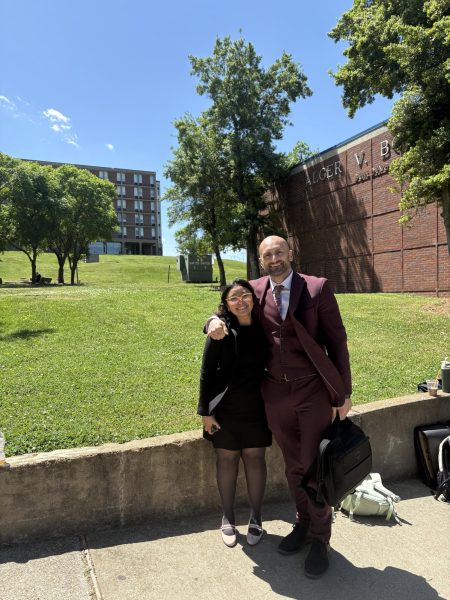
On April 16, NFA officially began. Tennessee’s humidity was the first to greet me upon arriving. Before the first round, I excitedly hugged and congratulated friends and competitors from Butte College, Illinois State, George Mason, Ball State, and University of Texas at Austin.
To outsiders, it is difficult to describe the amount of work required and how special it is to reach the national stage.
Founded in 1971, the National Forensic Association hosts the country’s premier collegiate speech and debate championship tournament. Students compete in 11 individual performing and speaking events along with Lincoln-Douglas debate.
Much like track and field, each event has its own structure and tenets. Individuals stylize their performance and speech within these restrictions. The only rules that encompass all events are to be memorized and do not go over time. To qualify an event for nationals, competitors must make it to finals and place in the top 20% at a tournament during the season. After competing in tournaments from Los Angeles to Peoria, Illinois, I qualified seven events: poetry, prose, dramatic interpretation, duo interpretation, rhetorical analysis, impromptu speaking and After Dinner Speaking.
The first round of the competition was prose. For my prose, I wrote an autoethnography analyzing the consequences surrounding the culture of manhood in America by exploring the relationship between myself and my grandfather. Self-authored programs are seen as somewhat taboo for interpretation events for a variety of reasons. It is tradition to adapt literature written by other authors to learn outside of one’s own experience. Also, there are complications around interpreting your own words.
Despite these unwritten rules, my coach Josh Hamzehee’s advice stayed with me: the main point of participating in these events is to get what we personally need from them.
I entered my first preliminary round carrying familiar feelings of fear and self-doubt. Within the classroom sat 5 competitors that seemed to be managing similar interdialogues, along with two judges idling behind the laptops they will use to rank us from first to last. Speaking first, I took a deep breath and gathered myself. Before I could process the moment, my first round was finished.
By the end of the tournament’s third day, preliminary rounds had concluded. Only the top 48 competitors in each event advanced to elimination rounds. Octafinals have three judges and the same number of competitors in each round.
On April 19, break announcements revealed I had advanced in three events: After Dinner Speaking, Rhetorical Analysis and Dramatic Interpretation.
The relief came with heartbreak for the events that didn’t make it. Considering the fate of your pieces are decided by judges, people who are subjective and bias as impartial we all try to be, it is important to fully embrace and be in the moment.
At Nationals, every performance is an entire year of countless practices, advocacy, vulnerability, trial, tribulation, culminating in that single moment. Regardless of technical skill or ability, there is a kind of indescribable beauty when witnessing the end product. It awakens the desire to be present, to listen, and to learn from the experiences of your fellow competitor.
This shared vulnerability is the essence of what makes this activity so special.
Knowing I had another opportunity to spread my message and voice was invigorating, especially for dramatic interpretation(DI). The manuscript for my DI was cut from an episode from the podcast Pablo Torre Finds Out titled Watching the Dallas Cowboys on Death Row. The piece follows the story of Charles Flores, a Cowboy superfan that was wrongfully convicted of murder.
Advocating for Flores’s release with his execution date nearing made every performance that much more precious.
The DI Octofinal round had a few of the most talented and captivating performers on the entire circuit. Aaron Anderson from TSU, Ella Bynane and Windsor Bissell from UT Austin, three individuals whom I am honored to share the platform with.
Before my performance, I looked at Flores’ mugshot and reminded myself why the story mattered. Every movement and line carried the possibility that it could be the final performance of the season.
When quarterfinal breaks were announced later that night, both my After Dinner Speaking and Dramatic Interpretation pieces had advanced.
For Quarterfinals, the top 24 competitors in each event are split into four separate rounds of six. With 5 judges in every round, the top three scores move on.
ADS is a persuasive or informative speech that uses humor to bring lightness to serious topics. The dichotomy crafted in the event makes it one of the more fun to perform and watch. I picked my ADS topic from my lived experience, the housing crisis and the unhoused.
During the years I spent on the streets, I never imagined there being a day I’d stand in front of an audience and share the causes, effects, and solutions to my personal struggles. Who would ever listen to the thoughts of an individual that has done everything in their power to not hear the voices in their head? The forensic speech and debate community.
What made this ADS round even more special was that my favorite performer in the entire country, Julia Irvine from Butte College, was in it. I can’t even begin to describe the amount of admiration I have for her. Without Julia pathing a path for me to follow, learn, and be motivated upon, I would have never developed the voice I have today.
The final day of the tournament arrived April 20. My ADS survived the semifinals and advanced to the finals. Standing beside my coach, Josh Hamzehee, as the final round banner dropped remains one of the most meaningful moments of my forensics career.
Hamzehee believed in me before I believed in myself. Every speech I have performed carries his influence. Finals were held in the Performing Arts Center. Before taking the stage, I took a moment to reflect on the labels I have carried throughout my life: high school drop out, drug addict, thief, bum, convict.
My eyes filled with tears with the realization that I had already won, regardless of outcome.
When my name was announced, I took the stage to a roaring round of applause. Even though the bright lights partially obscured the faces within the packed theater, I have never felt more seen in my life.
Together, we laughed, cried, and awed. I stepped out of the spotlight knowing I did everything in my power.
I spent the rest of the round watching two of my favorite people on the circuit, Hayden “Danger” Adams from Ball State and Kenzie Hart from Illinois State.
Then came the awards ceremony inside the Gentry Center.
After seven rounds of competition, hundreds of performances, and an entire year of work, only two names remained.
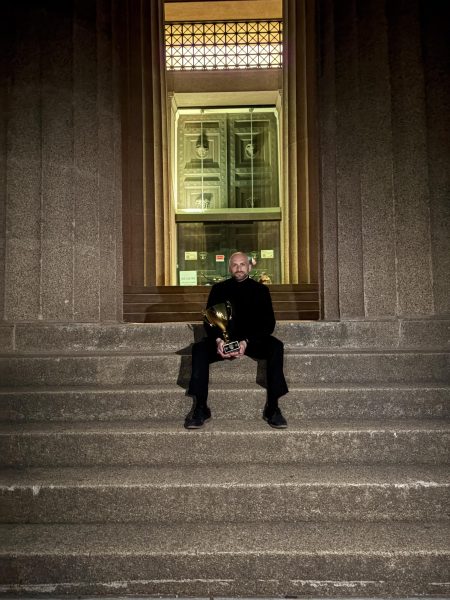
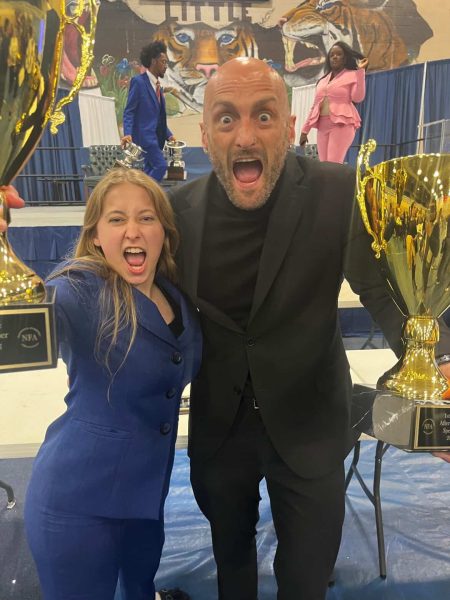
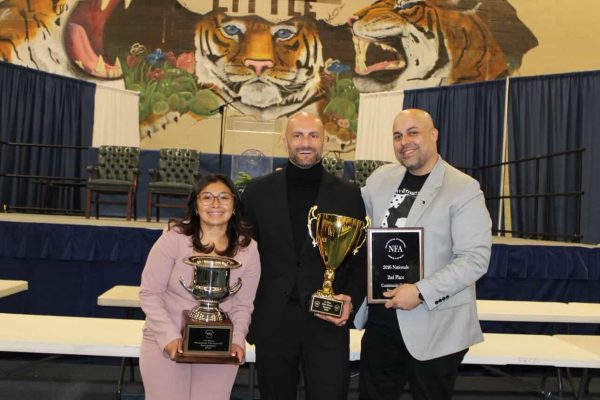
“And your national champion in After Dinner Speaking is … Salvatore Barone.”
For me, this moment meant more than a national title. I may not fully know who I am yet, but I know my voice and experiences deserve to be heard.