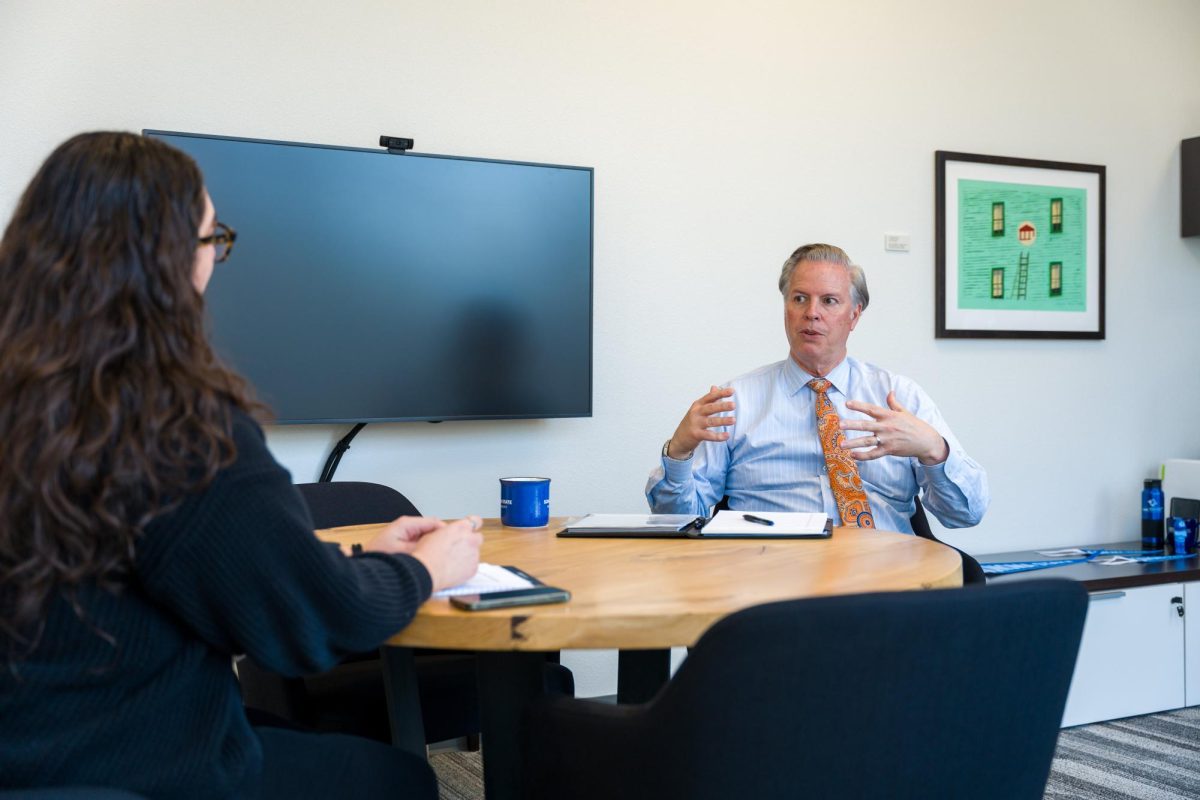


Austin Murphy is a journalist currently working for the local regional paper – the Press Democrat. But throughout his time in the profession, there have been a lot of high and low points. After dropping out of football at Colgate University, Murphy brought his experience with sports to journalism, when he started writing for his school paper. After he graduated, he landed a gig at Sports Illustrated, where he talked with professional athletes across a variety of sports and met five U.S. presidents.
However, he was laid off in 2018 due to downsizing, and ended up delivering packages for amazon for a few months, which he wrote a story on that was featured in The Atlantic titled “I used to write for Sports Illustrated, now I deliver packages for Amazon.” He got back into journalism in 2019 when he was hired by the Press Democrat, but now his scope has widened, covering all kinds of news in the world beyond sports, including what happens here at Sonoma State.
Early writing and getting hired:
Q: How do you get started with writing?
A: My journey writing, I ended up as a writer in part because we moved frequently. So I would be in some math class and have no idea what was going on and I was forced to contemplate academic dishonesty just to pass. But when I got to college it was very easy because I knew there were a lot of things I wasn’t going to major in, and English was one of the few options I really was drawn towards. I just sorta ruled out doing anything else, pulled up the drawbridge behind me.
Q: What drew you into sports Journalism?
A: “I have described myself as an ‘accidental sports writer’, I had sent quite a few resumes and clips out when I was a senior that spring, to paper editors across the country, and got some encouraging replies along the lines of ‘hey nice cover letter, we don’t have anything for you right now, but please stay in touch.’ And so I guess one of the lessons I have is I have only ever been hired after going through the initial process, applying, you send in a cover letter, resumes, but for me, that always got crickets, including at my local newspaper right outside of college. There was a group of local Penn State high school football players that were headed to a football camp. I talked to some of the Penn State coaches about our local players, because people love local news. I got some quotes and wrote a story for the Bucks County Courier Times that they had not asked me to write. I remember I put it in a manilla envelope and slid it under the door. I didn’t hear back from them for a couple weeks, but one Sunday, there it was on the front page of the sports section, heavily edited. Then a couple of days later I got a call from their editor asking me to work for them. It helped that I had some experience as an athlete even though I was a mediocre athlete, it increases your comfort level, one that I have not necessarily had as a general reporter for the Press Democrat.”
Time at Sports Illustrated:
Q: How did you land at Sports Illustrated?
Same deal! After the Bucks County Courier Times position came to an end, it’s my first autumn outside of college and instead of playing sports, I’m writing about them for the local paper. Making $22.50 per story, so I would make more money on the mileage, getting to the games, then working for the paper. And I think there was another situation where I was determined to make this my career, I was gonna make it as a writer, and I had kind of locked myself into it. Anyways, I did the same thing with Sports Illustrated, I sent them an apparently humorous essay that I didn’t hear back from them for months, I was living with my parents in Chicago in our unfinished basement, where I set up an office, and then one day, an Envelope back from sports illustrated, that was thicker than most of the rejection letters I had been getting. And it had the good news that they were gonna run this humorous essay and it also put me in good stead for the next fact checker/reporter position that came open. So that was a good day back in 1984, and that was how I put my foot in the door.
Q: What was one of your most difficult stories to write?
A: I spoke to Bill Clinton on a spawning story on Lance Armstrong that a source sent. I remember I had to ask him difficult questions like ‘oh hey they said in the hospital when they asked you if you had taken any performance enhancing drugs, and you had taken about five, is that right?’ and after the story, Lance called and the first words out of his mouth were “I thought we were friends.” And whenever you hear that as a journalist, you’re off the trail, I want to get along with everyone, but you’re not anyone’s friend – you’re an advocate for the reader of your publication. Lance called me back a few years later after he was about to lose a lot of his sponsorships and he was much much harsher and more threatening. And then he was out of cycling and I was out of Sports Illustrated and we both had to reinvent ourselves.
Q: How were you able to get in contact with five US Presidents while being a sports writer?
A: Well I was always a foot soldier at the magazine, doing mostly game of the week stories, sometimes features, very rarely long-form stories. Well, Scott Price got to play one-on-one with Obama. Obama was then senator Obama, and he was on a roll on his career. See, you can get them because they want to be associated with sports. Sports is sort of a common language that people can break the ice with. I was also invited to ride mountain bikes with then-president George W. Bush; there had been a lot of negative coverage with the Vietnam War and he wanted some coverage on him that was about ‘anything but the war’. But yeah, nowadays it’s hard enough to get your county supervisor, let alone the President. Sports Illustrated opened a lot of doors.
Books and Publishing:
Q: Have you ever considered writing a book?
A: “Not only have I considered it, I have written seven or eight! But I would say three of them have been ghost written where a publishing house says ‘oh we have a great story, someone with a great story here’ but they hire an author to tell their story. My most successful example was there was a wrestler at Arizona State who won a state and national title in, I think it was 2012, it was Anthony Robles, and he was exceptional because he had come out of his mother’s womb without a right leg. Interestingly, in high school, when he started he wasn’t very good at all, he would hop with one of his legs and the opponent would take advantage of it and the parents would say ‘isn’t that great that he’s trying.’ But by the time he was a Senior, he developed a style where he would get low like a sphinx, and had worked on his tensile strength, and he made opponents come to him and then he figured out a style where he went undefeated. At which point the parents of his opponents were saying ‘well if you think about it, he really has an unfair advantage since his leg is gone.’ Anyways, that was my favorite thing to write. Books are tough too right now, that is another business that is changing because it’s so easy now and relatively inexpensive to self publish. So there’s [less] hiring publishers.”
The Press Democrat, and consolidation of local papers:
Q: What was your reaction to the Press Democrat being bought by Alden Global Capital?
A: “We were shocked. We had sort of been on the threshold of being bought by Hearst, who owns the San Francisco Chronicle, and then at the last minute Alden Global Capital swooped in. We were all deeply concerned at that point whether we were going to be able to continue to do our job holding the powerful into account here in our coverage area. And I would add that at this time when there’s a lot of aggregating media companies, that simply pick up stories written by other media companies and halve our original content, at a time when there’s a lot of fake news out there.”
Q: Any plans after the Press Democrat, in case it goes under?
A: “I think the paper will be there just because their business depends on having outlets that produce stories and sell advertisements. That being said, I’m 64 and a half, I want to do it for a few more years. My wife thinks I can go longer, so we’ll try to compromise. In retirement, well, there really is no retirement these days, but I plan to write a couple more books.”
Q: What do you think the value of working for a local paper has been, and what should we do to protect community papers?
A: “I would posit that the job of local, regional papers has never been more important than it is today during Trump 2.0. And we’re super optimistic and full of resolve to keep doing what we do. We recently had an executive editor leave, searching for a new workplace, and on his way out the door he said ‘it’s a regional paper, but it’s a big city news room.’ It’s an overused phrase, but we feel like we punch over our weight class, meaning we overachieve. And I don’t mean to sound boastful, but we’re still going. There’s a lot of people executing a lot of important stories. And we’re gonna keep doing it.”